
Creative output that compounded into revenue, volume, and process gains.
Metrics reflect campaign-led creative, asset adaptation volume, and production workflow improvements across recurring Charles & Ivy marketing activity. Asset adaptations include resized, reformatted, channel-specific, and campaign-variant outputs across email, paid, organic, web, and print. Efficiency improvement is estimated against repeated manual rebuilds for recurring campaign formats.
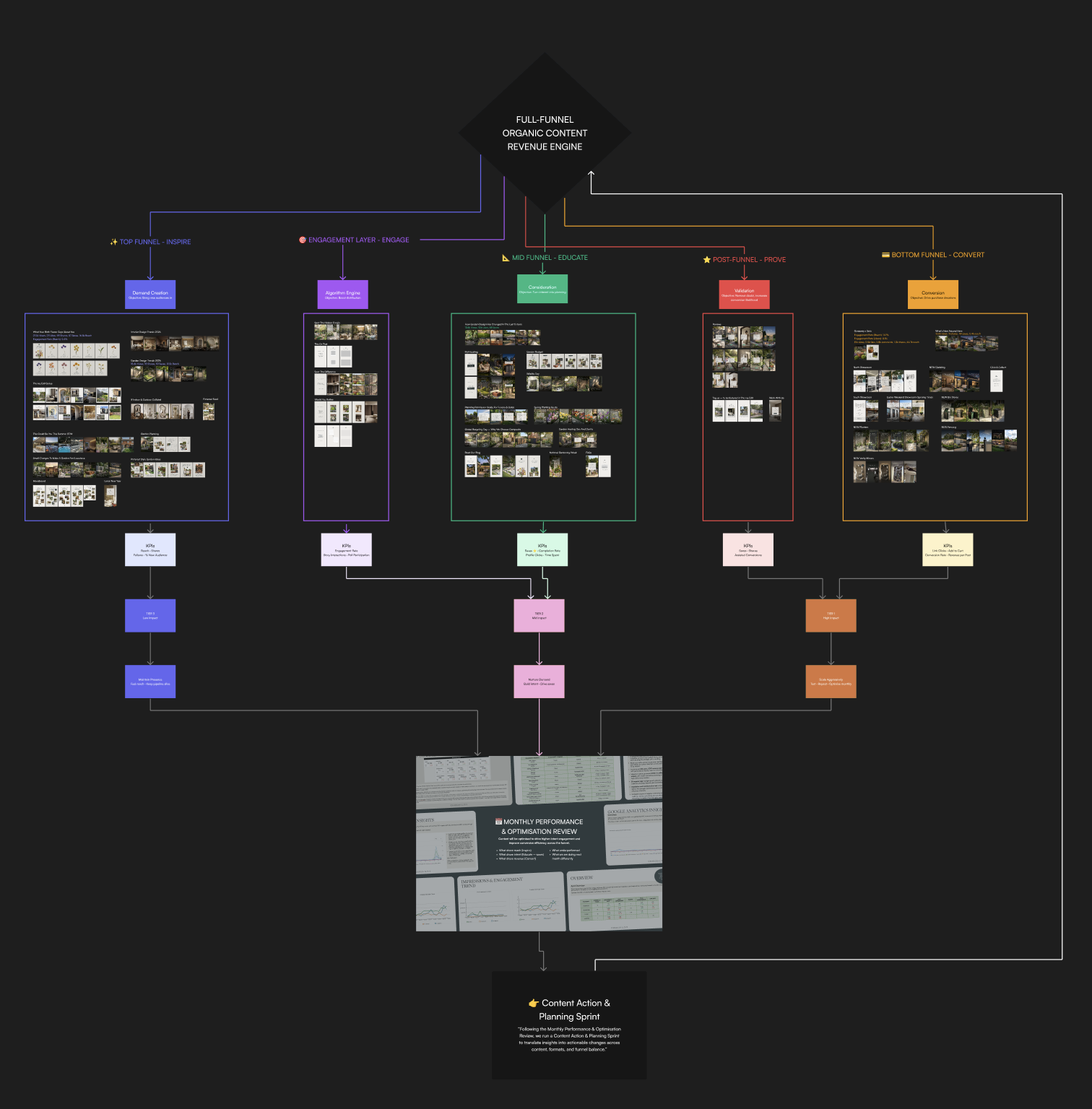
Full-funnel organic content framework — from awareness to revenue.
Shifted from isolated posting to reusable content pillars mapped across awareness, education, product proof, social proof, and conversion. Each post format was designed to repeat across campaigns without being rebuilt from scratch.
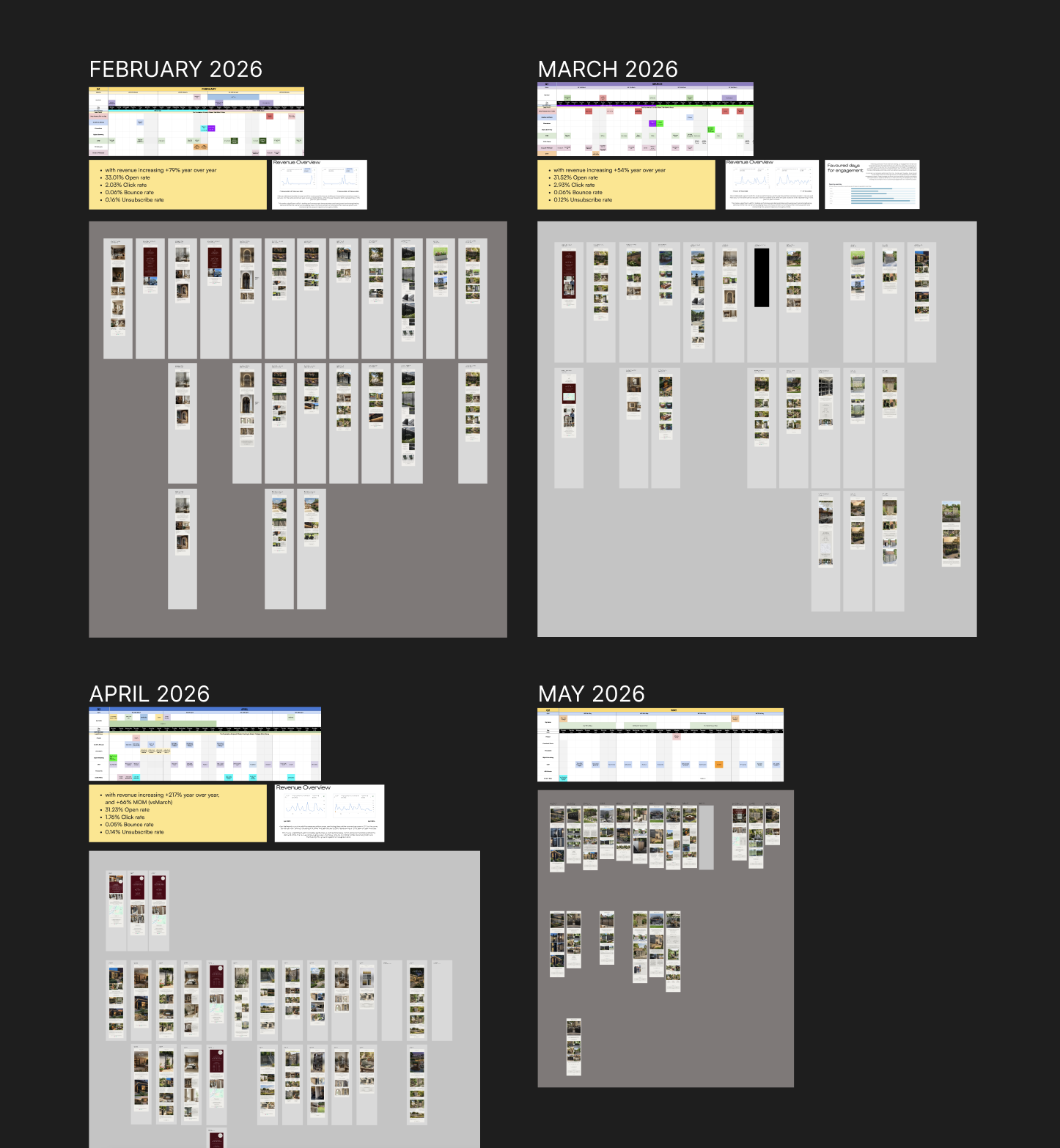
Modular weekly email system — built to ship on brand at pace.
Shifted from designing each send as a one-off to assembling recurring modules for launches, product stories, and promotional drops. One shared layout logic meant every email looked right without rebuilding from scratch.
Paid creative framework — vertical-first assets built for rapid testing.
Shifted from individual ad production to reusable hook, proof, transformation, and CTA patterns for faster testing. Format-native cuts for Meta and TikTok built around the same reusable structures — refreshable without restarting from zero.
Production, not ideation, became the bottleneck.
Charles & Ivy's marketing engine depended on continuous output: weekly email, daily social, frequent paid refreshes, web updates, and promotional campaigns. Demand wasn't the issue — throughput was.
Too many briefs started from scratch. That created slow turnaround, inconsistent hierarchy across channels, and production time being spent on routine rebuilds instead of higher-value campaign thinking. The issue wasn't one weak asset — it was accumulated inconsistency across hundreds of campaign executions.
Output that scales without losing consistency or intent.
- Speed: Brief → multi-channel asset set in days, not weeks.
- Consistency: One brand across email, social, paid, web, and print — regardless of who built which asset, or when.
- Scalability: Capacity grows through workflow logic, not headcount.
- Creative fit: Every asset reads as part of the same creative language, not a one-off.
- Creative space: Routine production compresses so launches, seasonal beats, and hero campaigns get real attention.
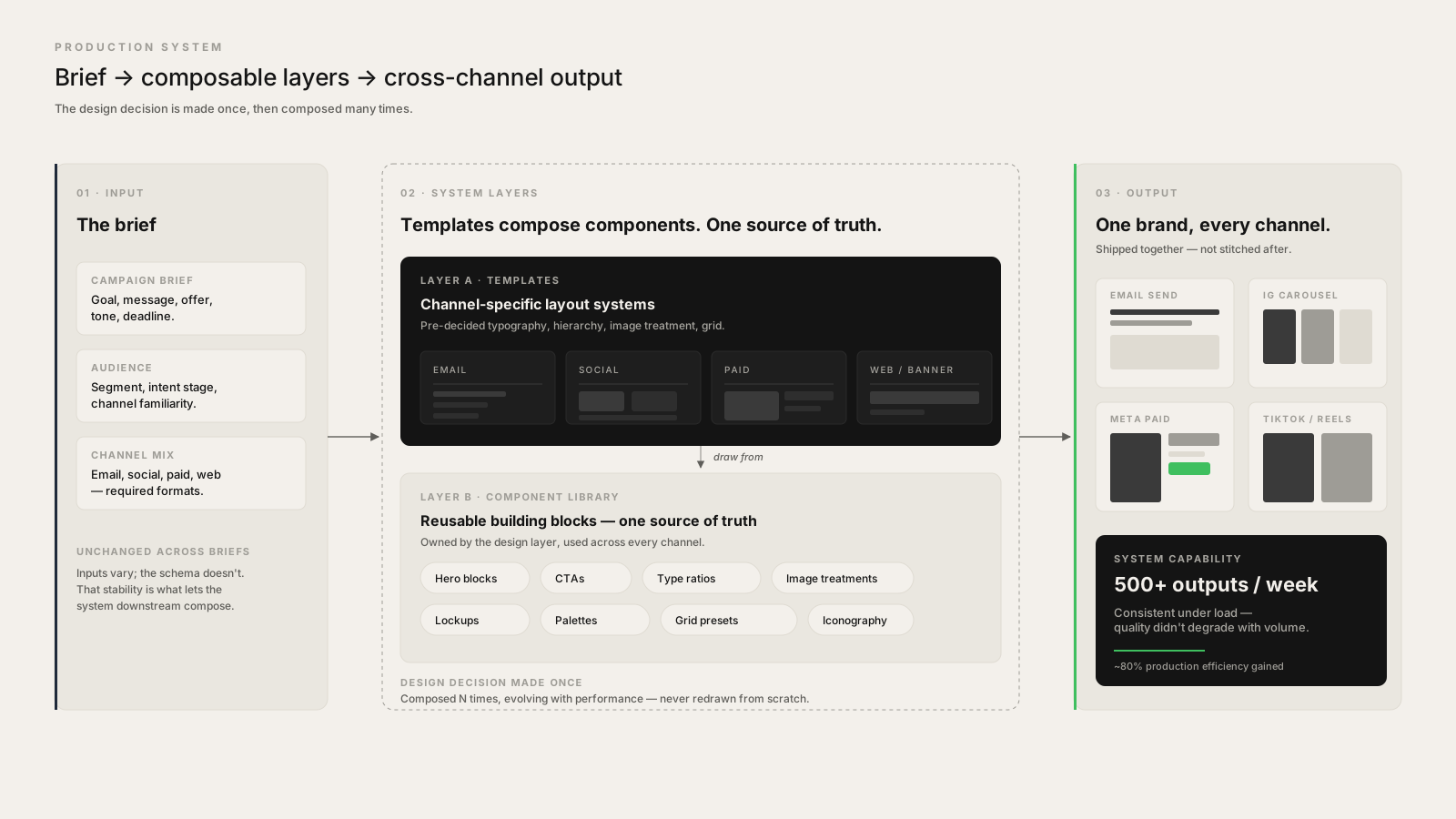
Creative production as a composable model, not a linear workflow.
The instinctive response to “ship faster” is “draw faster,” and at this cadence manual speed plateaus inside a quarter. The work shifted from producing each asset individually to defining the rules, components, and templates that allowed assets to be produced consistently. Each brief stops being a unique product and becomes an input. Each output stops being a one-off and becomes a composition.
The production model needed three layers:
Three approaches to scaling creative output.
- A · Linear production — redraw every brief from scratch. Highest creative control per asset, lowest throughput. Unsustainable beyond a few campaign cycles; brand drift creeps in anyway because the “control” is per-asset, not per-system.
- B · Full automation — templated dropdowns, zero design discretion. Fastest, cheapest. Fails on launches and seasonal moments where the brand needs to stretch — the workflow can't tell when it should bend.
- Chosen C · Hybrid system — templates set the floor, design judgement sets the ceiling. Speed without sacrificing brand consistency.
Balancing automation with creative control.
- Routine work compresses; creative work expands. Templates handle the 80% so the 20% gets real attention.
- Brand consistency becomes structural, not vigilant. One source of truth in the component library — fewer critical brand decisions left to memory under deadline pressure.
- Scales horizontally. New channel, new campaign type, new launch — all plug into the same components without rebuilding the framework.
- Preserves the brand without freezing it. The library evolves with performance data, so the production model improves instead of simply repeating.
Where the model breaks: inconsistency, failure, and variation.
- Cross-channel timing mismatch. Email and paid run on different cadences, so versioning had to live at campaign level, not asset level — otherwise channel teams shipped different versions of the same brand moment.
- Performance feedback loop. When paid data said a hero pattern under-performed, fixing the asset wasn't enough — the template had to be updated, or every future campaign inherited the broken assumption.
- New product categories with no existing template. The system needed an “intake” path that could absorb a genuinely new shape without breaking the rest. Solution: a frame-and-fill pattern for novel briefs, which fed back into the library once stabilized.
- AI variations drifting off-brand. Early experiments showed AI can produce variants that look on-brand at a glance but break subtle rules (type weight, hierarchy, palette balance). That failure mode became the brief for the structured-prompt thinking that drives the AI workflows I build today.
A production model capable of sustaining high-volume, high-quality output.
The operating model improved production consistency, increased the speed of recurring campaign delivery, and created a stronger foundation for performance-led creative iteration.
Commercial impact. Across campaign-led creative within my production scope, the model supported approximately £372k+ in annual campaign-influenced revenue, including £139.5k from email activity.
Channel performance. Email maintained a 30.64% open rate, 2.78% click rate, 0.05% bounce rate, and 0.14% unsubscribe rate. Organic social showed stronger month-over-month engagement across Facebook (+285% engagement rate), Instagram (+69% engagements), and TikTok (+37.6% engagement rate).
Production impact. More importantly, the team moved away from rebuilding every asset from scratch. Reusable components, templates, and clearer channel rules made high-volume output more consistent and easier to maintain.
What the model still doesn't solve.
- Performance feedback into templates: move from retrospective learnings to near-real-time template updates, so the library is always learning from what's actually winning.
- Segment-level variation: evolve from one-to-many campaign systems toward audience-specific creative variants, composed automatically from existing components.
- Component-level scoring: understand which hero layouts, CTAs, product frames, and visual patterns perform across campaigns — and have the library actively prefer what works.
- AI workflow bridge: connect structured templates with AI-assisted variation so scale increases without brand drift — the direction my current workflow practice takes this.
This work became the foundation for my current AI-assisted workflow practice — applying the same principles of consistency, scalability, and efficiency through structured generation, reusable inputs, and automated variation.
Credits & collaborators
- Role
- Creative Designer (Marketing)Campaign production · brand consistency · channel execution
- Team
- In-house marketingMarketing managers, copy, brand, paid media
- Channels
- Email · social · paid · webDaily / weekly cadence
- Tools
- Figma · Adobe CS+ early experiments with AI ideation tools
- Tenure
- 2024 — PresentCharles & Ivy, London
- Status
- Current roleFoundation for AI workflow practice