
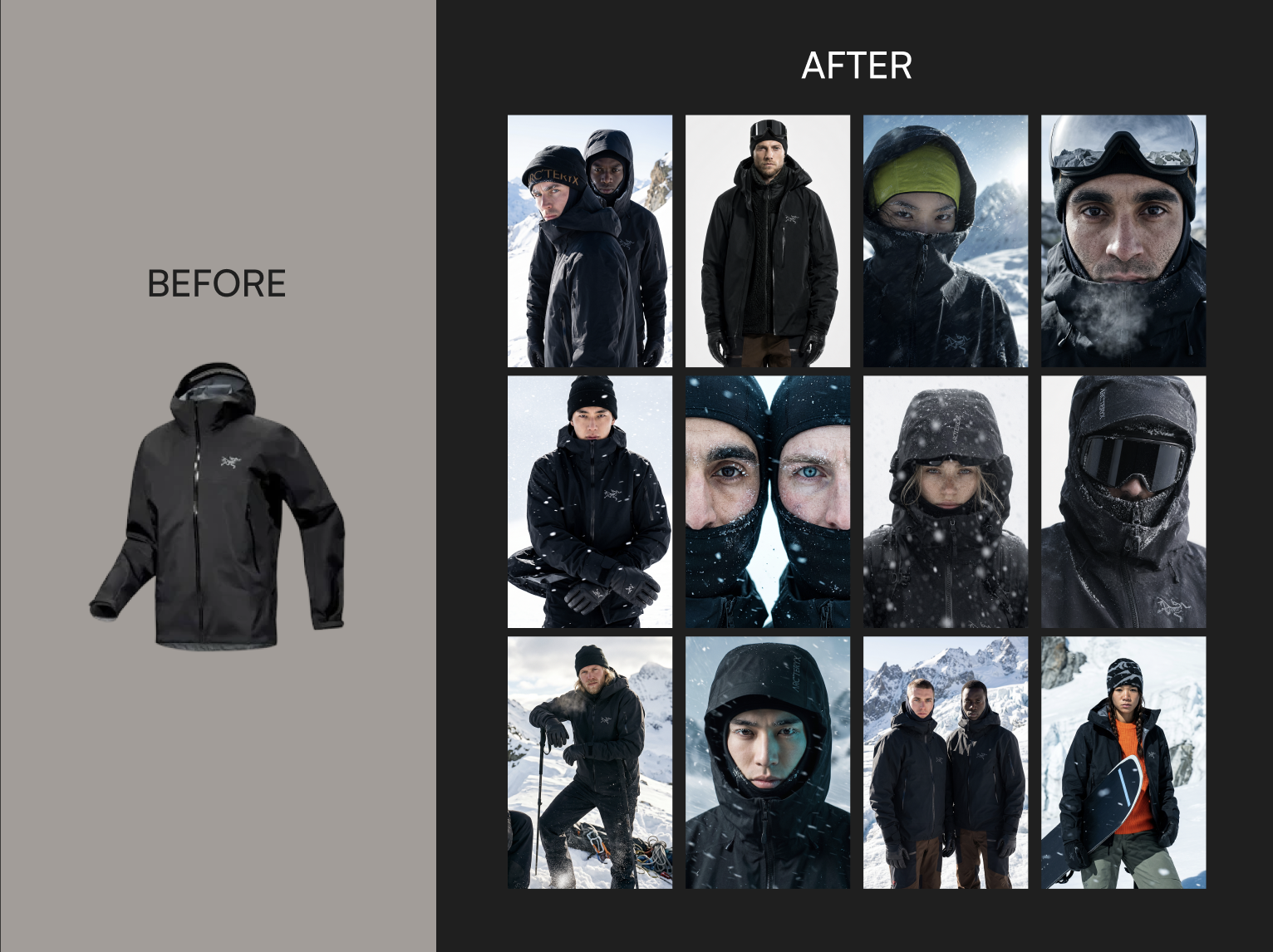
AI-assisted workflows that improved speed, scale, and production flexibility.
Metrics are based on comparing manual prompt-by-prompt exploration with the structured workflow across early-stage campaign concepting. Cost estimate includes replacing early-stage shoot exploration, location access, reshoots, and manual visual route development with AI-generated concept routes.
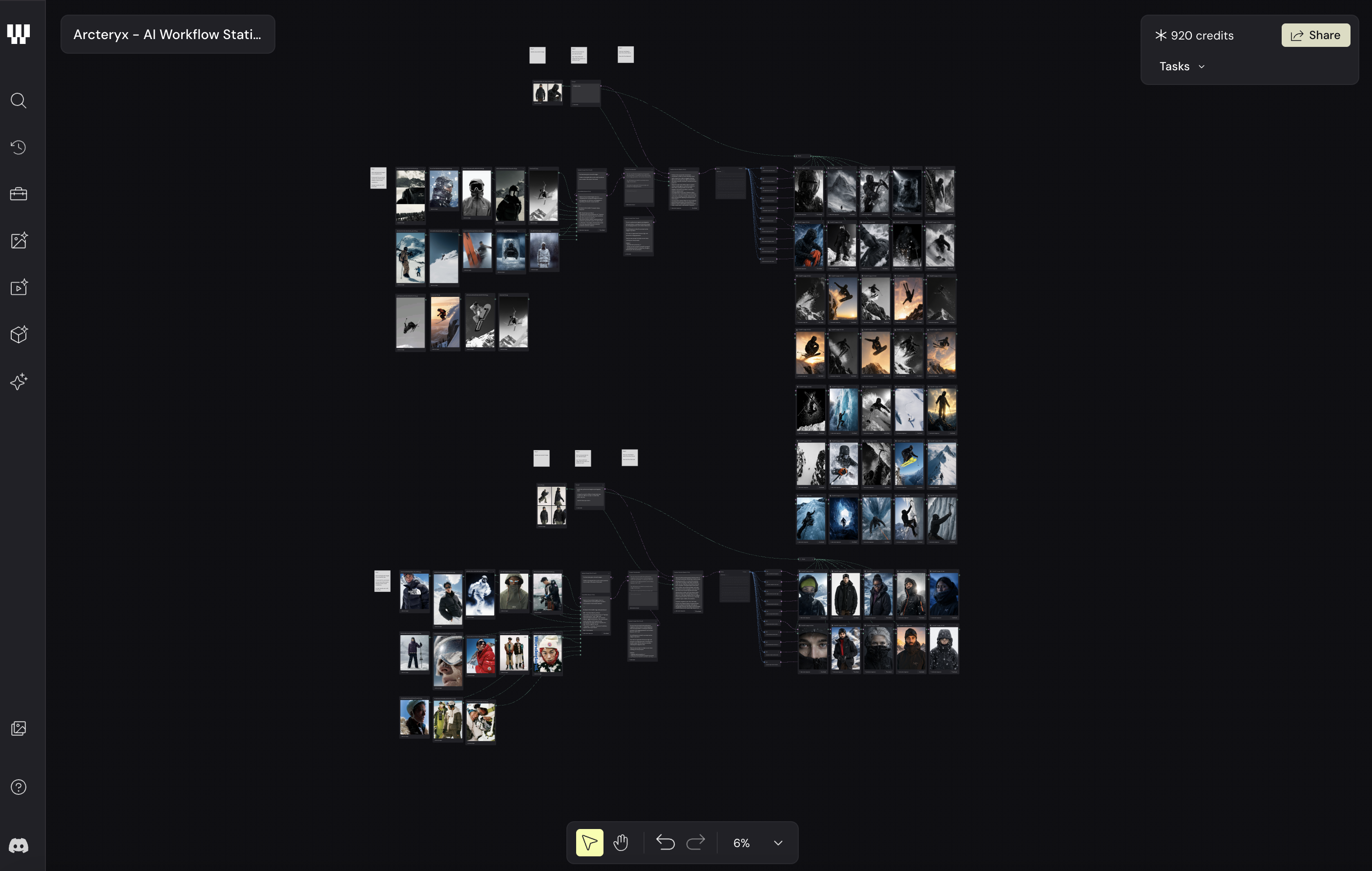
Generation is easy. Consistency at scale is not.
Generative tools make one-off visual exploration fast. The problem starts when a creative team needs related outputs: multiple routes, formats, products, channels, and refinements that still feel like they belong to the same campaign.
The failure mode was not lack of output. It was lack of repeatability: same brief, different results; every revision requiring new prompting; no reusable structure; no reliable way to scale from concept exploration to production-ready direction.
The issue wasn't prompting. It was structure.
The instinct is to invest in better prompts. The reframe was different: treat generative production as a structured workflow, not a prompting exercise. Structure the inputs, structure the workflow stages, structure the branching — and probabilistic generation becomes easier to control, compare, and refine.
Four design targets followed from that reframe:
- Consistency: related outputs should feel like one campaign system, not unrelated explorations.
- Scalability: output volume should increase without rewriting every prompt from scratch.
- Adaptability: one brief should support image, video, and channel-specific formats without rebuilding the workflow.
- Reviewability: weak outputs should be isolated, refined, or replaced without restarting the whole batch.
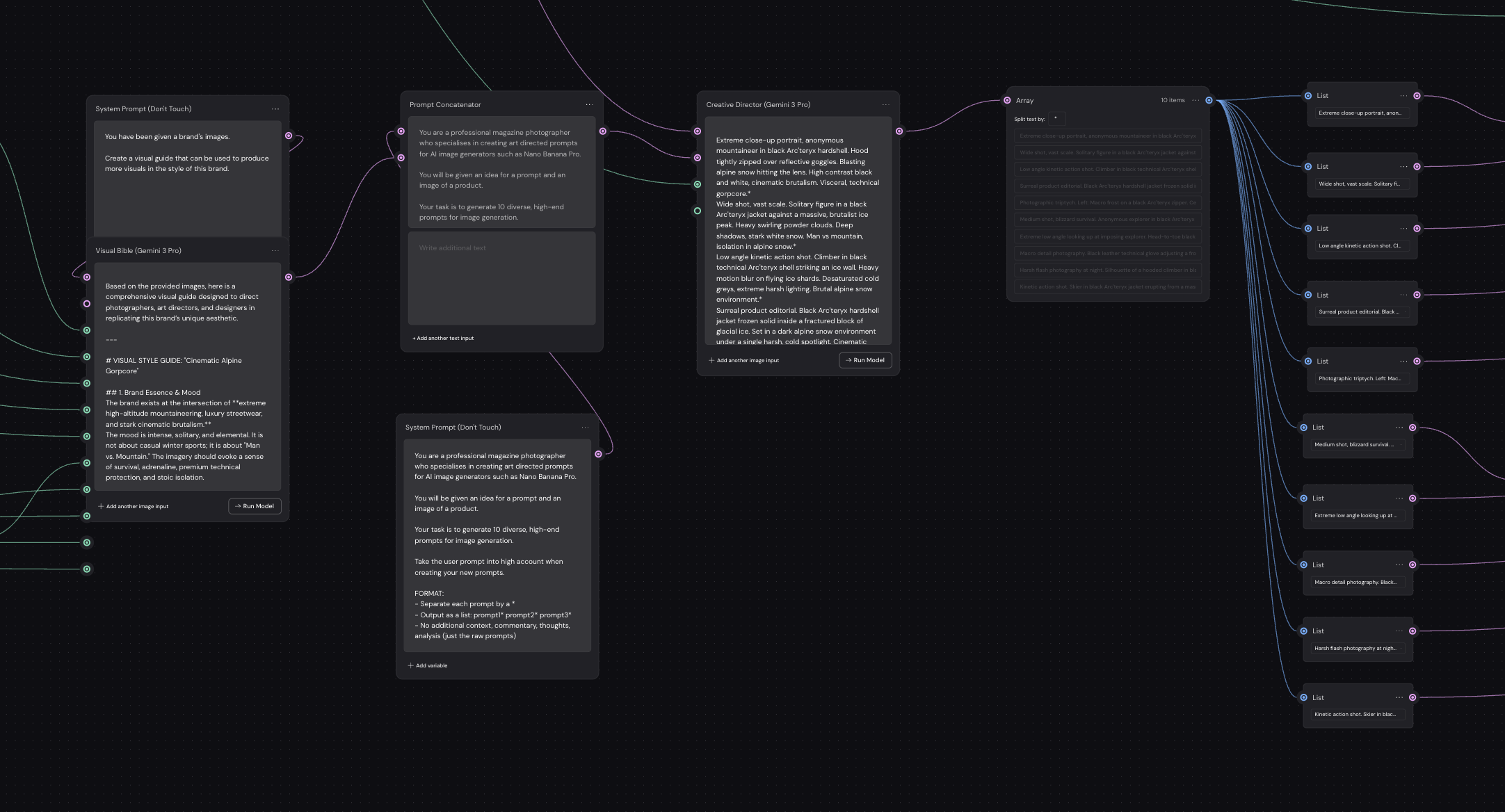
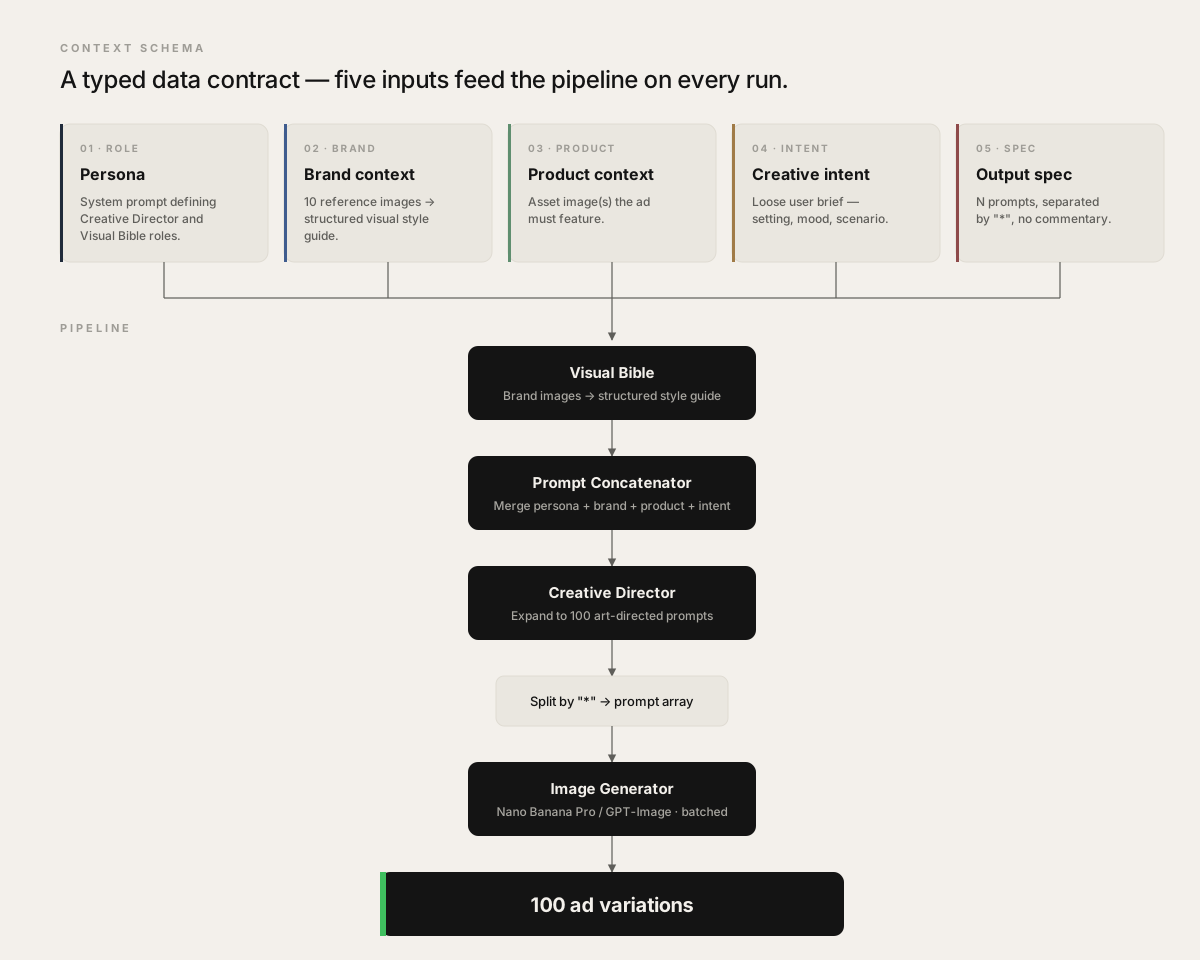
Separating brief, generation, refinement, and adaptation into independent stages.
Each stage has one job; the boundaries between stages are where control is introduced. Campaign intent is structured before generation runs. Generation runs in parallel. Refinement reuses prior outputs instead of regenerating from scratch. Each separation reduces the surface where inconsistency can enter.
- Stage 1 — Brief structuring. Turns raw campaign intent into reusable inputs: audience, offer, visual direction, constraints, and references. Free-form brief in, structured context out.
- Stage 2 — Route generation. Produces multiple visual directions in parallel instead of exploring one prompt at a time — covering the solution space in one pass, not five.
- Stage 3 — Visual refinement. Improves selected outputs without restarting the full workflow. Image-to-image refinement and style adaptation; prior outputs reused as inputs — the largest single efficiency gain in the system.
- Stage 4 — Format adaptation. Adapts chosen routes into social, paid, email, web, and video formats. One visual direction becomes many channel-ready outputs.
- Stage 5 — Review loop. Compares outputs, flags weak routes, and refines the input structure for the next pass. Restart the part that's wrong, not the whole batch.


Designing for control, not just output volume.
Four decisions defined the system's character. Each rejected a default behaviour of generative tools in favour of a more structural one.
- Structure over prompting. The unit of design isn't the prompt — it's the schema. Intent, style, and constraints become composable blocks; prompts become a render of those blocks, not the source of truth.
- Branching over iteration. Linear refinement explores one path slowly. Parallel branching explores many in parallel — the solution space gets covered in one pass, not five.
- Transformation over regeneration. The cheapest output is one you've already generated. Image-to-image and image-to-video pathways reuse work instead of starting over — compounding savings the deeper into the pipeline you go.
- Systems over tools. AI tools became components inside a workflow, not the workflow itself. The deliverable was the repeatable workflow, not a single successful prompt — one that has versioned, composable, and debuggable stages.
The trade-offs are real: parallel branching raises API cost per input; multi-stage execution compounds latency, especially for video; modularity adds debugging overhead. Weavy also lacks conditional logic, which constrains adaptive routing — a known limit that shapes the future-extension list.

One campaign brief, multiple creative routes, fewer production constraints.
Before the workflow, a brief produced a sequence: prompt → image → revision → prompt again. A handful of outputs per session, all slightly drifting from each other. After the workflow, the same brief produces a structured input, a parallel route generation pass, a visual refinement stage, and channel-specific format adaptations — all reviewable against the same brief.
A concrete example from campaign work:
The shift, in one line: generation stops being a one-at-a-time craft activity and becomes a production system that a creative team can operate, review, and direct.
The system improves consistency. It doesn't remove judgement.
Structure compresses variance; it doesn't replace taste. The system constrains what the model can produce, but a designer still has to decide which of the constrained outputs ships. That's not a flaw — it's the boundary the system was designed against.
- Taste isn't automatable. Models produce outputs that are technically correct but creatively weak. Ranking quality is easy; ranking rightness is human work.
- Evaluation is still a human loop. Automated scoring can sort the bottom 10% out, but the difference between the top three candidates is a designer's eye, not a metric.
- Edge cases require schema extension. Novel briefs — new product categories, new visual modes — don't fit the existing context schema. Someone has to redesign the input structure before the pipeline can absorb the work.
- The weak generations don't go away. Every batch has a bottom 10–20% that misses on subtle cues (type weight, palette balance, hierarchy). The system flags them faster; humans still triage.
- Review is the throughput ceiling. Generation is cheap. Deciding is the bottleneck. Scaling the system further means scaling the review loop — not the model.
The honest framing: this isn't a system that replaces creative judgement. It's a system that moves judgement upstream — from per-asset prompt-craft to reusable input design — and lets human review compound against a much larger output surface.
Scaling the review loop, not just generation.
The system made output faster, but review became the new constraint. The next iteration would focus less on generating more and more on helping teams decide faster.
- Output scoring: rank variations by brand fit, product clarity, and channel usefulness so the strongest routes surface without manual triage.
- Pattern memory: track which prompts, visual structures, and product framings repeatedly perform well, so the input schema improves over time.
- Human review shortcuts: create faster ways to compare routes without reviewing every asset individually — side-by-side evaluation, batch approve, selective re-roll.
- Production handoff: connect selected routes directly into campaign templates for social, paid, email, and web so there is no re-setup between generation and production.